Before connecting an Agent application, make three decisions: which system owns the Session history, where a credential may become plaintext, and when the task actually needs a Sandbox. These decisions determine whether work can resume and whether an operator can explain what happened.
Awaken keeps those choices inside one execution boundary. Client protocols enter through adapters, but they do not create separate histories or separate ways to authorize work.
Send every client into the same Session
Awaken accepts the official Anthropic SDK’s Managed Agents wire alongside AI SDK, AG-UI, A2A, and HTTP. An adapter handles authentication, validation, and DTO projection. Beyond that edge, every protocol enters the same Session, Thread, and Run. No adapter keeps a private conversation history.
flowchart LR
    SDK["Official SDK<br/>AI SDK · AG-UI · A2A"] --> A["Protocol adapters<br/>auth · validation · projection"]
    A --> S["Session<br/>Agent · Environment · resources"]
    S --> T[("Thread<br/>committed history")]
    S --> R["Run<br/>Running · Awaiting · Ended"]
    R --> P["Provider<br/>model inference"]
    R --> H["Hand<br/>local tools"]
    H --> B["Sandbox<br/>when policy requires"]
    P --> C[("Committed facts")]
    B --> C
When you add a client protocol, keep the adapter narrow: authenticate the request, validate it, and project its DTOs. Put the resulting work into the same Session, Thread, and Run used by every other client.
A live stream can update the interface quickly. After a disconnect, rebuild the
view from committed Thread facts. For approval, commit Awaiting and a
ResumeTicket before the interface shows a task to a person. This gives the
reconnected client one place to continue from.
Pin the credential before the Run starts
At credential ingress, a SecretStore seals the material. Agent publications
and Session baselines carry only credential id, revision, Workspace, usage, and
holder policy. At execution, Awaken checks those facts before the exact revision
reaches one selected last-mile holder.
sequenceDiagram
    participant U as SDK / Operator
    participant V as Vault ingress
    participant S as SecretStore
    participant P as Publication / Session
    participant A as Admission
    participant H as Selected holder

    U->>V: create or rotate credential
    V->>S: seal exact revision
    V-->>U: secret-free projection
    P->>P: freeze id, revision, usage, holder policy
    P->>A: request exact realization
    A->>A: verify scope, status, holder, capability
    A->>S: open only after admission
    S-->>H: local materialization / envelope / custody
Store credential id, revision, Workspace, usage, and holder policy with the Agent publication or Session baseline. At admission, check that exact reference. Open the sealed material only for the selected last-mile holder, then send the tool action through the Runtime permission gate.
Open-source, hosted, and enterprise deployments can use different SecretStore
or custody implementations. The rule stays the same: a Run cannot search for a
replacement credential after it has started, and possessing material does not
grant permission to use it.
Choose when the Sandbox should begin
Awaken separates the Session lifecycle from the physical Sandbox lifecycle.
eager realizes the environment before a backend or local resource uses it. A
Native on_tool_use Session can run model-only inference first and wait until
the first Hand tool to create its Sandbox.
flowchart LR
    S["Session created<br/>policy frozen"] --> P{"sandbox_provisioning"}
    P -->|eager| E["realize Environment<br/>image · mounts · network"]
    E --> X["start backend and tools"]
    P -->|on_tool_use + Native| N["run inference<br/>no Sandbox"]
    N --> D{"local state or<br/>Hand tool needed?"}
    D -->|no| N
    D -->|yes| R["realize one Sandbox"]
    R --> X
    P -->|on_tool_use + ACP / A2A| F["reject admission<br/>no silent fallback"]
Choose eager when the backend, input, Skill, or delegate needs a local
environment before inference. Choose Native on_tool_use only when model-only
work can begin without local state and the first Hand tool is the honest moment
to pay the startup cost.
Do not silently defer an unsupported combination. Filesystem inputs, a
filesystem Skill, or a published delegate require earlier realization. ACP and
A2A backends do not accept on_tool_use. Measure Session creation and the first
local tool separately. A warm pool may reduce cold-start time, but it does not
change isolation or ownership.
Check one operating record
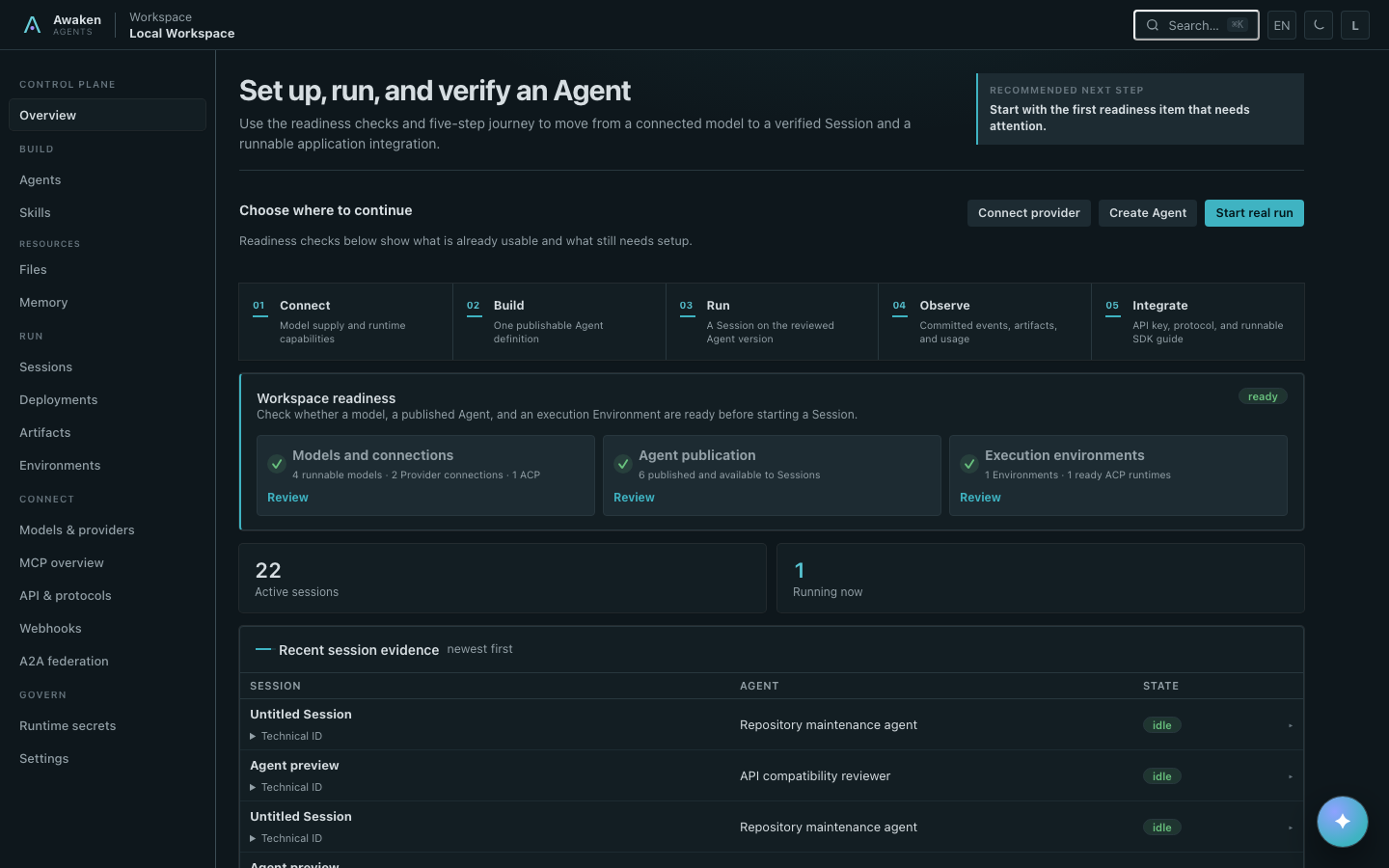
Use the Console to answer practical questions: which Run is current, which Provider and MCP connection it used, whether it is waiting for approval, and what was committed before a failure. The Console projects the same execution record; it does not ask the operator to reconcile a second state model.
The compatibility matrix owns exact external differences. Read the full designs in Sessions and events, Credential custody and last-mile realization, Brain, Hand, and Session Environment. If you are deciding how a Skill should load, continue with one Skill through files or semantic tools.